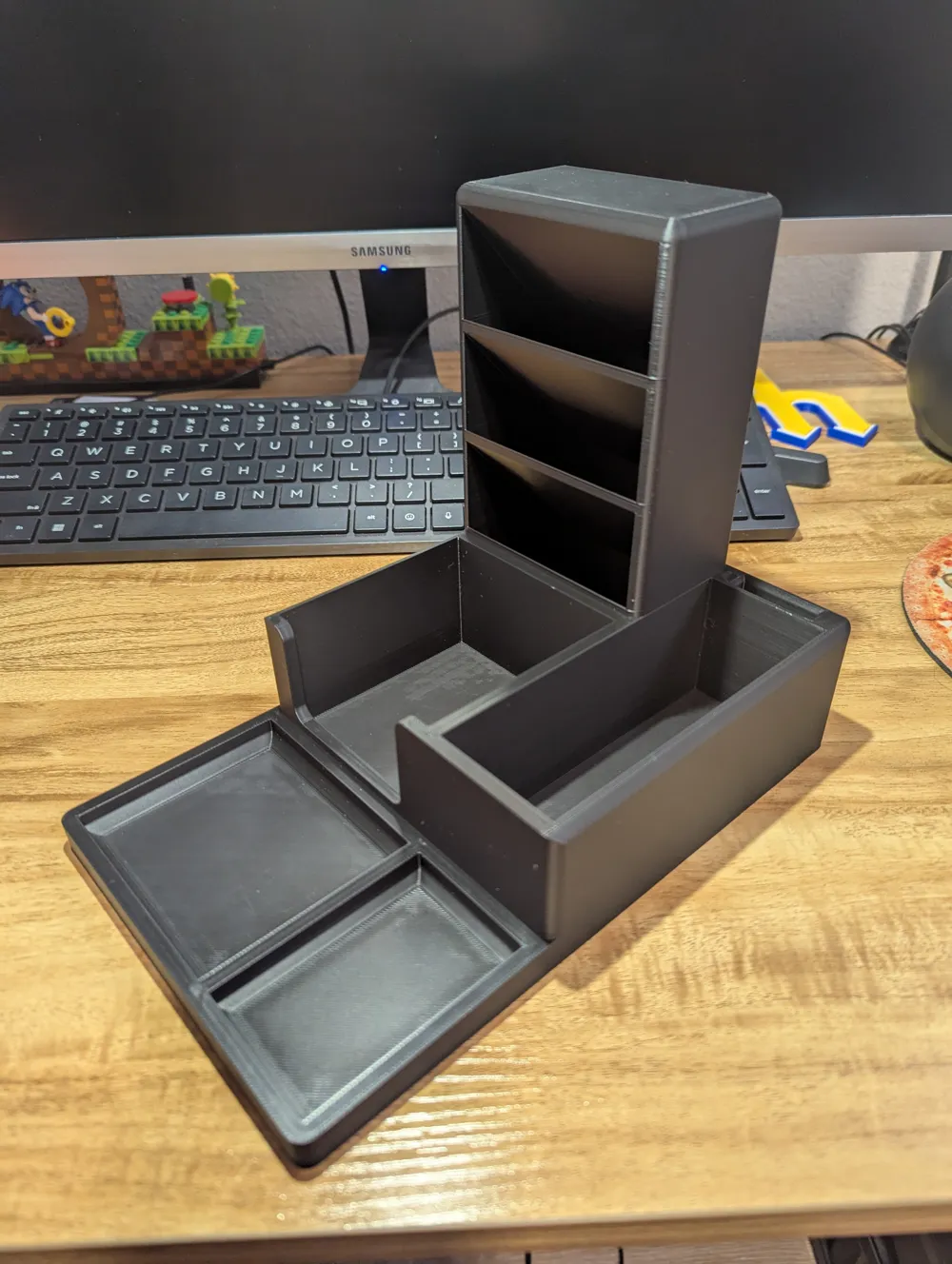
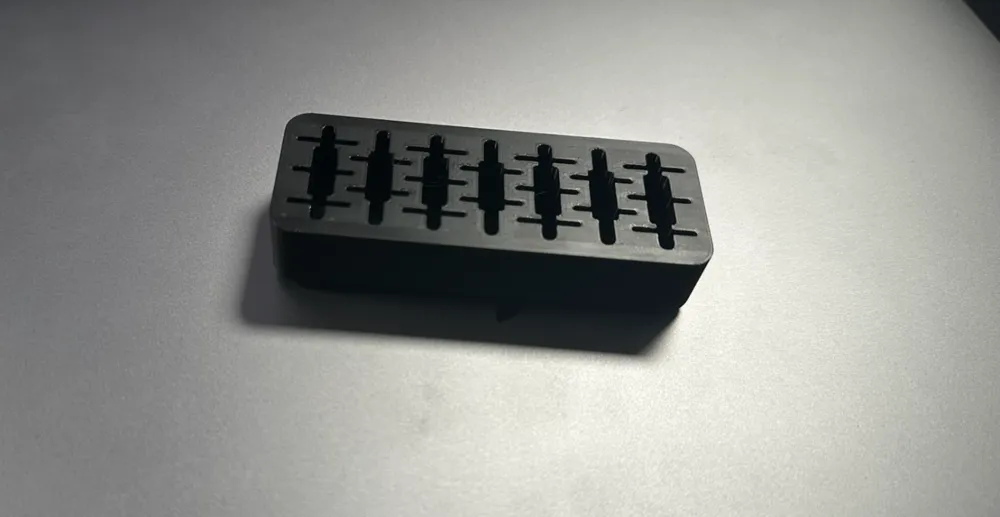
Ein Schreibtisch-Organizer mit Fächern für Stifte, Notizen und USB-Sticks bzw. SD-Karten. Das Modell gibt es als STL zum Drucken, der verbindende Winkel zusätzlich als STEP-Datei zum Anpassen in einem CAD-Programm.
Kompakter Schreibtisch-Organizer mit einer flachen Mulde für einen Post-it-Block, einem Block mit kreuzförmigen Steckplätzen für SD-Karten und USB-Stecker sowie zwei Stiftbechern dahinter.
Vorschau
Parameter
include <BOSL2/std.scad>
$fn = 48;
// =============================================================================
// Schreibtisch-Organizer "Stifte / Notiz / USB" (kompakte Variante)
//
// Vordere Reihe:
// 1. Notiz - flache, quadratische Mulde fuer einen Post-it-Block (76x76 mm)
// mit Griffmulde in der Vorderwand.
// 2. USB/SD - schmaler Block mit Universal-Steckplaetzen. Jeder Schlitz ist
// kreuzfoermig und quer angeordnet: der lange, duenne Arm nimmt
// SD-/microSD-Karten auf, der kurze, dickere Arm USB-A-/USB-C-
// Stecker. Der Block ist nur so breit wie ein Schlitz-Kreuz.
//
// Hintere Reihe (hinter Notiz + USB):
// 3. Stifte - zwei quadratische Becher nebeneinander mit sechseckiger
// Innenwand. Gleich grosse Quadrat-Grundflaeche, unterschiedliche
// Hoehen.
//
// Druck: so wie modelliert flach auf das Bett, keine Stuetzen noetig.
// =============================================================================
/* [Allgemein] */
// Wandstaerke (mm)
wall = 2.4;
// Bodenstaerke (mm)
floor_t = 2.4;
// Rundung der senkrechten Aussenkanten (mm)
corner_r = 3;
// Beschriftung an der Vorderseite eingravieren
show_labels = true;
/* [Notiz / Post-it] */
// Kantenlaenge der quadratischen Post-it-Mulde (mm)
postit_size = 78;
// Tiefe der Mulde (mm)
postit_depth = 20;
// Breite der Griffmulde in der Vorderwand (mm)
postit_scoop = 34;
// Tiefe der Griffmulde ab der Oberkante (mm)
postit_scoop_depth = 13;
/* [USB / SD - Kombibereich] */
// Anzahl der Universal-Steckplaetze
usb_slots = 5;
// Abstand der Steckplaetze von Mitte zu Mitte (mm)
usb_slot_pitch = 12;
// Schlitzbreite fuer USB-A / USB-C Stecker (mm)
usb_arm_w = 5.6;
// Schlitzlaenge fuer USB-A / USB-C Stecker (mm)
usb_arm_l = 13;
// Schlitzbreite fuer SD / microSD Karten (mm)
sd_arm_w = 2.8;
// Schlitzlaenge fuer SD / microSD Karten (mm)
sd_arm_l = 25;
// Einstecktiefe der Plaetze (mm)
usb_slot_depth = 22;
// Aussenhoehe des USB/SD-Blocks (mm)
usb_block_h = 30;
// Material rund um das Schlitzkreuz in Laengsrichtung (mm)
usb_margin = 5;
// Tiefe des USB/SD-Blocks (mm) - genug fuer die Schlitze + Rand
usb_block_d = 72;
/* [Stifte - quadratische Becher mit sechseckiger Innenwand] */
// Kantenlaenge der quadratischen Grundflaeche je Becher (0 = automatisch)
bucket_base = 0;
// Gesamthoehe des linken Bechers (mm)
bucket_h_left = 95;
// Gesamthoehe des rechten Bechers (mm)
bucket_h_right = 62;
// Wandstaerke an den Sechseck-Ecken (mm)
bucket_wall = 3;
/* [Hidden] */
eps = 0.05;
// ---- Vordere Reihe ---------------------------------------------------------
postit_ow = postit_size + 2 * wall; // Aussenbreite Notiz-Zone
front_y = postit_size + 2 * wall; // Tiefe der vorderen Reihe
usb_ow = sd_arm_l + 2 * usb_margin; // Aussenbreite USB-Block (schmal)
usb_ox = postit_ow - wall; // USB-Block schliesst an Notiz an
front_x = usb_ox + usb_ow; // Gesamtbreite der vorderen Reihe
postit_h = floor_t + postit_depth;
usb_h = usb_block_h;
// ---- Hintere Reihe (quadratische Becher) ---------------------------------
bb = bucket_base > 0 ? bucket_base : front_x / 2; // Kantenlaenge Quadrat
bore_d = bb - 2 * bucket_wall; // Eckmass der Sechseck-Bohrung
total_x = max(front_x, 2 * bb);
bucket_y0 = front_y - wall; // nur mit der Notiz-Rueckwand verschweisst
bucket_x0 = (total_x - 2 * bb) / 2;
total_y = bucket_y0 + bb;
// =============================================================================
// Bausteine
// =============================================================================
// Rechteckiger Aussenkoerper, Ecke vorne-links-unten im Ursprung.
module box_at(ox, oy, w, d, h) {
translate([ox, oy, 0])
cuboid([w, d, h], rounding = corner_r, edges = "Z",
anchor = LEFT + FRONT + BOTTOM);
}
// Kreuzfoermiger, quer liegender Schlitz-Ausschnitt (oben buendig).
// langer duenner Arm (X) -> SD / microSD
// kurzer dicker Arm (X) -> USB-A / USB-C
module slot_cutter() {
d = usb_slot_depth + eps;
union() {
cuboid([sd_arm_l, sd_arm_w, d], chamfer = 1.2, edges = TOP, anchor = TOP);
cuboid([usb_arm_l, usb_arm_w, d], chamfer = 1.2, edges = TOP, anchor = TOP);
}
}
// Quadratischer Becher (Vollmaterial). Die zur Nachbarwand zeigende Kante
// bleibt ungerundet, damit beide Becher sauber aneinander stossen.
module bin_solid(cx, cy, h, keep_edge) {
translate([cx, cy, 0])
cuboid([bb, bb, h], anchor = BOTTOM,
rounding = corner_r, edges = "Z", except = keep_edge);
}
// Sechseckige Bohrung eines Bechers (vom Boden bis oben offen).
module bin_bore(cx, cy, h) {
translate([cx, cy, floor_t])
cyl(h = h - floor_t + eps, d = bore_d, $fn = 6,
anchor = BOTTOM, chamfer2 = 1.6);
}
// Eingravierte Beschriftung auf der Vorderwand (y = 0).
module front_label(str, cx, z, size = 5) {
translate([cx, 0.8, z])
rotate([90, 0, 0])
linear_extrude(1)
text(str, size = size, halign = "center", valign = "center");
}
// =============================================================================
// Organizer
// =============================================================================
module organizer() {
postit_cx = postit_ow / 2;
usb_cx = usb_ox + usb_ow / 2;
bucket_cx_l = bucket_x0 + bb / 2;
bucket_cx_r = bucket_x0 + bb * 1.5;
bucket_cy = bucket_y0 + bb / 2;
slot_band = usb_slots * usb_slot_pitch;
slot_y0 = (usb_block_d - slot_band) / 2;
difference() {
union() {
// Notiz-Zone
box_at(0, 0, postit_ow, front_y, postit_h);
// USB/SD-Block
box_at(usb_ox, 0, usb_ow, usb_block_d, usb_h);
// Quadratische Becher mit sechseckiger Innenwand
bin_solid(bucket_cx_l, bucket_cy, bucket_h_left, RIGHT);
bin_solid(bucket_cx_r, bucket_cy, bucket_h_right, LEFT);
}
// --- Notiz-Mulde ---
translate([wall, wall, floor_t])
cuboid([postit_size, postit_size, postit_depth + eps],
rounding = 2, edges = "Z",
anchor = LEFT + FRONT + BOTTOM);
// Griffmulde (nur durch die vordere Wand)
translate([postit_cx, wall,
postit_h + postit_scoop / 2 - postit_scoop_depth])
xcyl(l = postit_scoop, d = postit_scoop);
// --- USB/SD Steckplaetze (quer, in Reihe nach hinten) ---
for (i = [0 : usb_slots - 1])
translate([usb_cx, slot_y0 + usb_slot_pitch * (i + 0.5), usb_h])
slot_cutter();
// --- Sechseck-Bohrungen ---
bin_bore(bucket_cx_l, bucket_cy, bucket_h_left);
bin_bore(bucket_cx_r, bucket_cy, bucket_h_right);
// --- Beschriftung ---
if (show_labels) {
front_label("NOTIZ", postit_cx, postit_h * 0.5);
front_label("USB SD", usb_cx, usb_h * 0.5, size = 4);
}
}
}
organizer();
Ein Clip, der auf eine rechteckige Schiene schnappt und Etiketten oder kleine Ablagen aufnimmt. Das Modell ist parametrisch, sodass du es an deine Schiene anpassen kannst.
Vorschau
Parameter
include <BOSL2/std.scad>
$fn = 100;
/* [Rail] */
// Width of the rectangular rail the clip snaps onto (mm)
rail_w = 4;
// Height of the rectangular rail (mm)
rail_h = 3;
// Clearance on each side of the rail width - smaller = snugger (mm)
rail_clearance_w = 0.05;
// Clearance above the rail height - smaller = snugger (mm)
rail_clearance_h = 0.15;
/* [Clip] */
// Length of the clip along the rail (mm)
clip_len = 16;
// Wall thickness of the clip sides (mm)
wall = 1.2;
// How far the retaining lips reach in under the rail (mm)
lip_reach = 0.7;
// Height of the retaining lips / how far the rail is lifted off the wall bottom (mm)
lip_height = 1;
// Lead-in chamfer on the lips so the rail funnels in (mm)
lip_chamfer = 0.6;
/* [Label plate] */
// Length of the label plate, along the rail - keep >= clip length (mm)
plate_l = 24;
// Width of the label plate, sticking out to the side (mm)
plate_w = 18;
// Thickness of the label plate (mm)
plate_t = 1.6;
// Corner rounding of the plate (mm)
plate_rounding = 2;
/* [Preview] */
// Show the rail in the preview (never exported)
show_rail = true;
/* [Hidden] */
ch_w = rail_w + 2 * rail_clearance_w; // channel inner width (Y)
ch_h = rail_h + rail_clearance_h; // channel inner height (Z)
outer_w = ch_w + 2 * wall; // outside width of the clip
ceil_z = lip_height + ch_h; // top of the walls = underside of the plate
// =========================================================================
// Clip
//
// A C-shaped channel that grips a rectangular rail. The rail rests on the
// two inward lips (lifted `lip_height` off the wall bottom) and is held down
// by them; the plate on top stops it lifting out. The lips carry a lead-in
// chamfer on the inner bottom edge so the mouth funnels the rail in.
// =========================================================================
module clip() {
// Side walls + retaining lips, mirrored across the centre plane.
mirror_copy([0, 1, 0]) {
// Wall.
translate([0, ch_w / 2 + wall / 2, ceil_z / 2])
cuboid([clip_len, wall, ceil_z]);
// Retaining lip: lead-in chamfer on the inner bottom edge so the
// mouth funnels the rail in, while the flat top face keeps a square
// 90 deg edge that locks under the rail.
translate([0, ch_w / 2 - lip_reach, 0])
cuboid([clip_len, lip_reach + wall, lip_height],
chamfer = lip_chamfer,
edges = FRONT + BOTTOM,
anchor = FRONT + BOTTOM);
}
}
// =========================================================================
// Label plate
//
// Flat plate for a sticker and the closed top of the clip in one. One long
// edge is flush with the clip wall; the plate sits on the full clip top and
// cantilevers out to one side.
// =========================================================================
module plate() {
y_off = (plate_w - outer_w) / 2; // flush with the -Y clip wall
translate([0, y_off, 0])
cuboid([plate_l, plate_w, plate_t],
rounding = plate_rounding,
edges = "Z",
anchor = BOTTOM);
}
// =========================================================================
// Assembly
//
// Print recommendation: plate flat on the bed, clip pointing up. The
// channel then opens upwards and the lip chamfers are self-supporting.
// =========================================================================
module ablage_clip() {
clip();
translate([0, 0, ceil_z])
plate();
}
ablage_clip();
if (show_rail && $preview)
color([0.5, 0.5, 0.5, 0.3])
translate([0, 0, lip_height + rail_clearance_h / 2 + rail_h / 2])
cuboid([clip_len + 40, rail_w, rail_h]);
Ein Haken für einen 25 x 3 mm Scheibenmagneten, der durch eine unten liegende Tasche eingesetzt wird. Das Modell liegt bereits in Druckorientierung vor, sodass die Schichten entlang der Belastung laufen.
Vorschau
Parameter
/*
Magnetic hook for a 25 x 3 mm disc magnet
-----------------------------------------
ASSEMBLY: the magnet slides into the pocket from the TOP EDGE of the back
plate and clicks past a small ridge. After that it is trapped on every
side: a thin skin towards the metal, the solid wall towards the hook, the
pocket walls all around. Pulling the hook off a whiteboard or a fridge
leaves the magnet in the hook, not on the board. To get it out again,
push it back up through the slot.
The skin costs holding force - a 3 mm magnet is very sensitive to the air
gap, so keep it thin. back_skin = 0 gives an open back (magnet touches the
metal, strongest hold), but then only friction and glue keep it in place.
PRINTING: the file is already in print orientation - it lies flat on its
side, Z is the build direction. Large flat first layer, and the layers run
along the hook, so the load pulls *along* them instead of peeling them
apart at the root (that is what breaks hooks printed standing up).
The back plate has to be as wide as the magnet, the hook does not:
hook_w = 14, hook_chamfer = 2.5 slim hook, no supports (default). The
hook edges taper to a ridge so nothing
is flatter than 45 deg, but the ridge
under the curve still starts in mid-air
- expect it to look rough down there.
hook_w = 14, hook_chamfer = 0 same hook with flat sides. Cleanest
result, but print it with supports.
hook_w = plate width (31) chunky version: the whole part is one
extruded profile, prints perfectly with
nothing at all to clean up.
A slim hook only touches the bed with the back plate and then grows a
25 mm cantilever sideways - use a brim.
*/
/* [Magnet] */
// Magnet diameter (mm)
magnet_d = 25;
// Magnet thickness (mm)
magnet_h = 3;
// Extra diameter so the magnet slides in (mm)
magnet_fit = 0.3;
// Extra depth of the channel (mm)
magnet_play = 0.2;
// Skin between magnet and metal - holds the magnet in, 0 = open back (mm)
back_skin = 0.8;
// Solid wall on the hook side of the magnet (mm)
front_wall = 1.6;
// How far the retaining ridge overlaps the magnet, 0 = plain slot (mm)
slot_grip = 0.25;
// Length of the lead-in ramp above that ridge (mm)
slot_ramp = 1.5;
/* [Back plate] */
// Material around the magnet (mm)
plate_margin = 3;
/* [Hook] */
// Thickness of the hook arm, seen from the side (mm)
arm_t = 5;
// Width of the hook - at or above the plate width gives the chunky version (mm)
hook_w = 14;
// 45 deg chamfer on the hook edges - arm_t/2 prints without support, 0 = flat sides (mm)
hook_chamfer = 2.5;
// Distance over which the hook widens into the plate. Keep it <= half the
// width it has to bridge, otherwise the flare becomes a >45 deg overhang (mm)
hook_flare = 7;
// Straight part of the arm before the curve (mm)
arm_len = 10;
// Radius of the hook curve, centre line (mm)
hook_r = 7;
// Sweep of the curve - 180 = tip points straight back, less opens the mouth (deg)
hook_sweep = 170;
/* [Details] */
// Radius of the fillets in the inner corners (mm)
fillet = 3;
// Rounding of the outer edges of the profile (mm)
edge_round = 0.8;
// Segments of the hook curve
hook_steps = 48;
// Segments of the straight arm - only needed so the flare comes out smooth
arm_steps = 8;
$fn = 96;
/* ---------- Derived ---------- */
pocket_d = magnet_d + magnet_fit;
pocket_depth = magnet_h + magnet_play;
plate_t = back_skin + pocket_depth + front_wall; // 5.6 mm
plate_h = magnet_d + 2 * plate_margin; // 31 mm
width = plate_h; // overall width of the plate
magnet_y = plate_h / 2; // centre of the magnet, in use: up
magnet_z = width / 2; // centre of the magnet, across the hook
arm_y = arm_t / 2; // centre line of the arm
arm_end_x = plate_t + arm_len; // where the curve starts
curve_cx = arm_end_x;
curve_cy = arm_y + hook_r;
root_x = plate_t + fillet; // up to here the hook keeps full width
slim = hook_w < width;
/* ---------- Centre line of the hook ---------- */
function hook_pts() = concat(
[ for (i = [0 : arm_steps])
[ arm_t / 2 + (arm_end_x - arm_t / 2) * i / arm_steps, arm_y ] ],
[ for (i = [1 : hook_steps])
let (a = -90 + hook_sweep * i / hook_steps)
[ curve_cx + hook_r * cos(a), curve_cy + hook_r * sin(a) ] ]
);
// Full width at the root, hook_w once the flare is over
function width_at(x) =
width + (hook_w - width) * min(1, max(0, (x - root_x) / hook_flare));
/* ---------- Body: 2D profile (X = away from the wall, Y = up) ---------- */
module seg(p1, p2) {
hull() {
translate(p1) circle(d = arm_t);
translate(p2) circle(d = arm_t);
}
}
module hook_path() {
pts = hook_pts();
for (i = [0 : len(pts) - 2]) seg(pts[i], pts[i + 1]);
}
module profile() {
// Keep the back dead flat - nothing may stick out behind the magnet face
intersection() {
translate([0, -50]) square([200, 200]);
// offset(+r) offset(-r) rounds the outer corners (applied last),
// offset(-r) offset(+r) fills the inner corners with a fillet (applied first)
offset(r = edge_round) offset(r = -edge_round)
offset(r = -fillet) offset(r = fillet)
union() {
square([plate_t, plate_h]);
hook_path();
}
}
}
/* ---------- Width envelope for the slim hook ---------- */
// Round bead with 45 deg chamfers on both ends. Swept along the centre line
// it gives the hook a cross section that is pointed in build direction, so
// the underside never turns into a flat face hanging in the air.
module bead(p, w) {
r = arm_t / 2 + 0.05; // a hair over the profile, avoids
// coincident faces in the intersection
// No chamfer where the hook is still as wide as the plate - that part sits
// flat on the bed and must stay square. It grows in as the hook narrows.
c = min(hook_chamfer * (width - w) / (width - hook_w), r - 0.2, w / 2);
translate([p.x, p.y, magnet_z])
hull() {
cylinder(r = r, h = max(w - 2 * c, 0.02), center = true, $fn = 32);
cylinder(r = r - c, h = w, center = true, $fn = 32);
}
}
module width_envelope() {
// Full width around the plate so the root fillets survive the intersection
cube([root_x, plate_h, width]);
pts = hook_pts();
for (i = [0 : len(pts) - 2])
hull() {
bead(pts[i], width_at(pts[i].x));
bead(pts[i + 1], width_at(pts[i + 1].x));
}
}
module body() {
if (slim)
intersection() {
linear_extrude(height = width) profile();
width_envelope();
}
else
linear_extrude(height = width) profile();
}
/* ---------- Magnet pocket ---------- */
// Circle with a 45 deg roof, cut off flat at the top of the circle. A plain
// round hole lying on its side droops at the top because every perimeter
// hangs over the one below; here nothing is flatter than 45 deg.
// Tip points towards local -X, which the rotation below turns into "up".
module teardrop_2d(r) {
intersection() {
hull() {
circle(r = r);
translate([-r * sqrt(2), 0]) circle(r = 0.01);
}
translate([-r, -r]) square([2 * r, 2 * r]);
}
}
// Pocket seen from the front: the magnet seat plus the slide-in slot that
// runs out through the top edge of the plate.
module pocket_2d() {
r = pocket_d / 2;
union() {
teardrop_2d(r);
translate([-r, 0]) square([2 * r, plate_h]);
}
}
module magnet_pocket() {
// rotate([0,90,0]): local +Z becomes +X (the pocket axis),
// local -X becomes +Z (the flat roof ends up on top),
// local +Y stays +Y (the slot points up)
translate([back_skin, magnet_y, magnet_z])
rotate([0, 90, 0])
linear_extrude(height = pocket_depth)
pocket_2d();
}
// Ridge on the inner face of the front wall. The magnet snaps past it - the
// 1.6 mm wall bends out of the way - and is then held down by the flat face
// underneath.
module slot_ridge() {
x1 = back_skin + pocket_depth; // inner face of the front wall
y0 = magnet_y + pocket_d / 2; // just above the seated magnet
d = magnet_play + slot_grip;
translate([0, 0, magnet_z - pocket_d / 2])
linear_extrude(height = pocket_d)
polygon([[x1 - d, y0], [x1, y0], [x1, y0 + slot_ramp]]);
}
/* ---------- Model ---------- */
module magnet_hook() {
union() {
difference() {
body();
magnet_pocket();
}
if (slot_grip > 0) slot_ridge();
}
}
magnet_hook();